
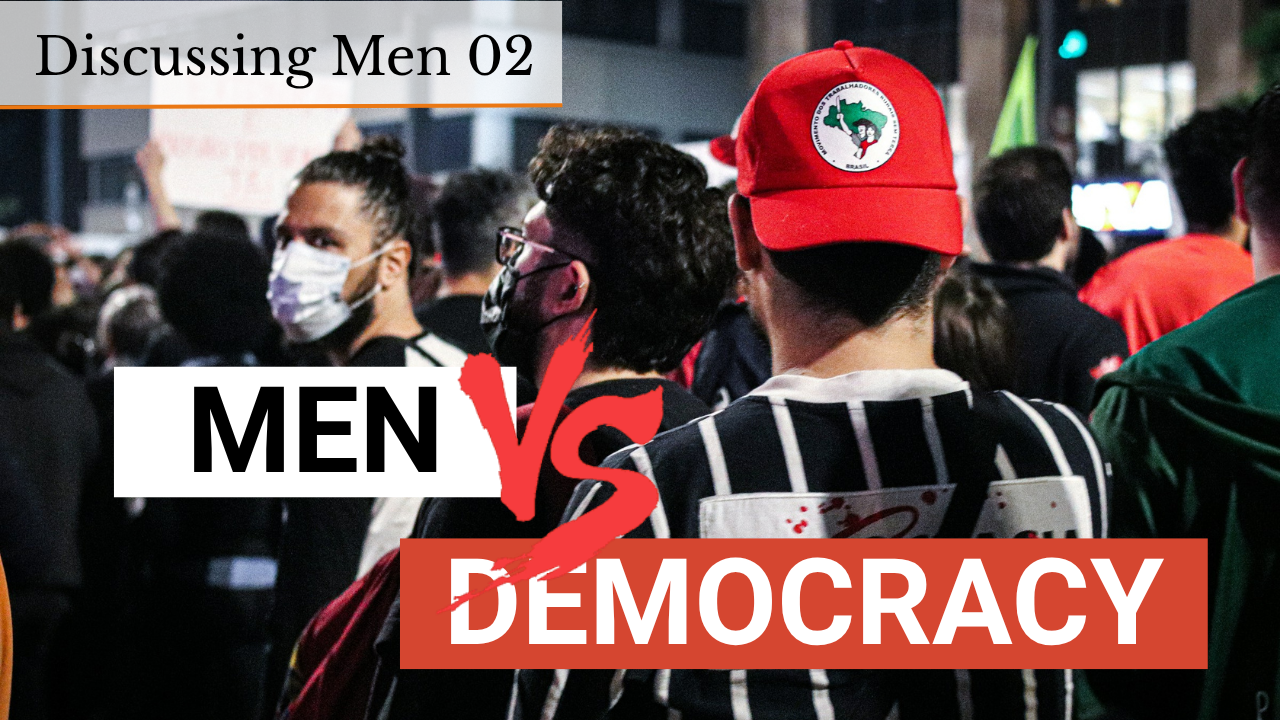
What happens when boys searching for belonging find answers rooted in dominance instead of care, and what can we do about it? How to foster democratic masculinity?
The phrase “crisis of masculinity” gets thrown around so often that it risks becoming background noise. The “crisis of democracy” too. What I appreciated about this report is the insistence that these are not two separate crises that occasionally bump into each other. They are parts of the same system. If democracy is weakening, we should expect some of the pressure to show up in gender. And if boys and men are being pulled into rigid, dominance-heavy identities, we should expect democracy to pay the bill.
These reflections follow a discussion I hosted for professionals working with men and boys. We talked about the Democratic Masculinities best-practices report produced within the Men for the Future of European Democracies project. We were joined by Jan Hessel (Emancipator, Netherlands), one of the report’s authors, which made the discussion unusually grounded and practical. You can watch the whole thing here:
Is the democracy problem a masculinity problem?
A lot of us grew up assuming democratic norms were basically stable: imperfect, contested, but ultimately self-repairing. The last decade has seriously challenged this safe belief. Principles many of us treated as solid and safe have taken strong hits.
But it would be way too cheap to just say that ‘men are the problem.’ However, many men these days feel quite insecure in the changing world, and insecurity creates vulnerability, and vulnerability attracts dubious entrepreneurs. Economic shocks, unstable work, widening inequality, the sense that the world is unpredictable and unfair… none of this is gender-neutral in its effects, but it becomes especially combustible when filtered through a socialization that teaches boys to interpret uncertainty as shame.
And then come the political actors who know how to profit from that shame.
The report’s framing lands because it refuses to separate “radicalization” from the everyday emotional and cultural landscape of male upbringing. The report states:
Antidemocratic movements feed on men’s loneliness, pain, and their search for meaning, belonging, and significance in a world that feels increasingly complex, unstable, and disconnected.
That’s not moral condemnation. It’s a map.
The authors’ point was that work on masculinities doesn’t happen in a vacuum. There are forces tapping into these insecurities and offering stability, direction, and certainty. The problem is what kind of certainty: rigid ideas of masculinity that promise relief but produce a logical endpoint of more extreme political views.
This is the pivot that matters. The ‘solution’ being offered isn’t just bad for women, minorities, or democracy in the abstract. It’s bad for the boys themselves. It trains them into a posture that makes real connection harder, and then sells them dominance as compensation for the connection they’re losing.
The Manosphere isn’t an ideology. It’s belonging, packaged as power
There is something I think we underestimate: many boys aren’t radicalized by ideology first. They’re recruited by recognition.
Many of the world’s old certainties are disappearing religion, neighbourhoods, stable work, rootedness, long-term friendship groups. This affects everyone, but there is a specifically male bind there: boys still hear ‘be a provider’ even though this might be neither possible nor needed. The old roles shrink, the new roles are unclear. And leaning into feminine-coded qualities is still socially punished.
So boys learn to compete, to hide vulnerability, to be rational, to not speak their inner life. They experience a kind of double loneliness: the loneliness of not expressing their pain, and the loneliness of believing you’re the only one struggling because other boys don’t show it either.
Then they go online. And there they find answers that are not only clear-cut, but professionally produced, algorithmically delivered, and backed by money.
This is why a line from the report really stayed with me:
Antidemocratic narratives exploit male isolation by offering promises of power, control, and dominance as substitutes for basic human needs—love, belonging, and meaning.
That “substitute” dynamic is the whole tragedy. If you sell a lonely person dominance as medicine, you don’t just fail to heal them. You teach them to distrust the very practices that would heal them: openness, mutuality, vulnerability, asking for help.
It becomes a self-perpetuating circle: the more someone invests in hierarchical dominance, the harder it is to get the belonging they were actually seeking. Love and meaning don’t arrive on command because you acquired status symbols. Even if you get the Ferrari moment, it’s a gleaming second. Then what?
Meanwhile, the damage the Manosphere does is incredible because there are real issues in the background that demand effort, thought, and care. Instead, boys get misdirected towards bad solutions. They’re told it’s a zero-sum competition, and they’re taught to resent women for not needing them in the old ways. That bitterness against women and feminism doesn’t appear out of nowhere. It’s cultivated.
But there’s a tension here worth naming. We can’t treat boys as passive sponges for Tate-style messaging. But they are smarter than that. They interpret, resist, contradict themselves. There are many ways to reach them and they will be responsive if we talk to them about the things they actually care about and offer solutions which really work for them.
Hessel, the author of the report, often delivers workshops in schools. When he asks teens for role models, many say “my father,” and when asked why, the answer is often: “because he is sweet.”
Sweet. Not dominant. Not rich. Not feared. Sweet.
Which tells us something hopeful: beneath the veneer of ‘cool,’ a lot of boys already know what actually feels human. And we can tap into it.
If we want democratic men, we need democratic environments
The report’s big practical move is to shift from prevention to empowerment. That word can make people flinch (‘male empowerment’ sounds dangerous), but in the report it is used carefully: not empowering dominance, but empowering men’s capacity for care, relationship, and democratic participation.
How to do this? The report looked at the practice of dozens of organisations working with men and boys and distilled three most successful mechanisms:
- fostering empathy
- transforming together
- messaging that focuses on care and empowerment
The togetherness of the project, the meeting of other men in an empathic way, the witnessing of everyone’s struggles and challenges – that is the best antidote for the dominance and power-based mindsets peddled elsewhere. It’s about building safety with your hands: remove tables, sit in a circle, co-create group norms, make the room more egalitarian. Create spaces where men don’t fold into the defensive posture but open up to searching for answers. Thankfully, men’s circles are on the rise and it’s amazing to see evidence supporting their effectiveness.
But then there’s accountability. A space that allows expression but never challenges harmful claims isn’t a men’s circle; it’s an accelerant. It’s what incel forums do. We need spaces where men can express themselves but also be reminded that it’s not all about them – and reminded in a positive and encouraging way, because if he is ‘thrown out of a bar’ for saying problematic things, well, he’ll just go elsewhere – and probably do much worse.
So we need trained adults who can do both: validate the underlying need and challenge the harmful conclusion. Sometimes you reverse perspectives, sometimes you use humor, sometimes you go direct with facts. The point is to be ready, because the issue is multifaceted and the response has to be multifaceted too. My current work focuses on collaborating with various NGOs across Europe to develop a practitioner’s toolkit:
Can being good also be cool?
There is one more discomfort that I still think we need to face. A lot of our “better masculinity” language is morally correct but aesthetically weak. The manosphere doesn’t just sell ideas; it sells vibes. Tires screech. Cameras cut fast. Everything looks like coolness, wealth, and effortless belonging.
Meanwhile, caring masculinity and democratic masculinity often gets marketed like a public health leaflet.
That’s not a joke. It’s a strategic weakness. If we want to meet boys where they are, we have to take seriously the fact that many boys want to feel cool, strong, admired, and alive. If our only answer is to stay morally strong and do the right thing, we’re going to lose. You might as well run a ‘Just Say No’ campaign against drugs.
Moreover, the world rewards simple messages, but life is complex. If you want to draw attention to this complexity, you’re going to have a frustrating task. Sure, you can’t bench-press yourself out of depression – but it doesn’t stop millions of people from trying. So how do you make things simple enough for people to actually engage with, yet avoid surrendering nuance?
Now, of course, that’s not to say that boys and young men are incapable of resisting cool images. Their instincts are often more pro-human than the culture they consume. The problem is representation. So part of the work is rebranding what is cool and awesome: showing authority figures who lead with care, teachers who greet boys at the door and ask how they are, men who can be respected without being emotionally illiterate.
It’s not making boys less like boys. It’s widening the repertoire. You can love football and also learn emotional processing. You can be rational and also be relational. Being all that shouldn’t exclude half of life.
And then there’s the structural point: this can’t be solved purely bottom-up. NGOs can do excellent interventions, but the problem is systemic. If ministries of education know where boys are for five hours a day, then “how do we reach them before Tate?” isn’t a mystery. It’s a question of political will.
So here’s my takeaway: we need a two-level strategy.
We need early, embedded education that teaches how to do human connection before the crisis hits. And we need compelling, culturally literate narratives that make democratic masculinity feel not only right, but also awesome and desirable. And I mean early. Because if boys are never asked what they think until they’re 18 and suddenly told to care about democracy, we shouldn’t be surprised when they choose the loudest certainty on offer.


Leave a Reply